
In 20 years of selling dental practices, one problem has come up again and again. A sole practitioner starts to slow down, drops a day or two, and the fees slide. Before long the practice is below $500,000 in fees, and many brokers will tell the owner it simply won’t sell.
There are thousands of these practices across Australia. They have loyal patients, working equipment and experienced staff, and many of their owners also own the building. Yet a dentist can often earn as much working for a corporate as they could by buying one, so the usual buyer walks away.
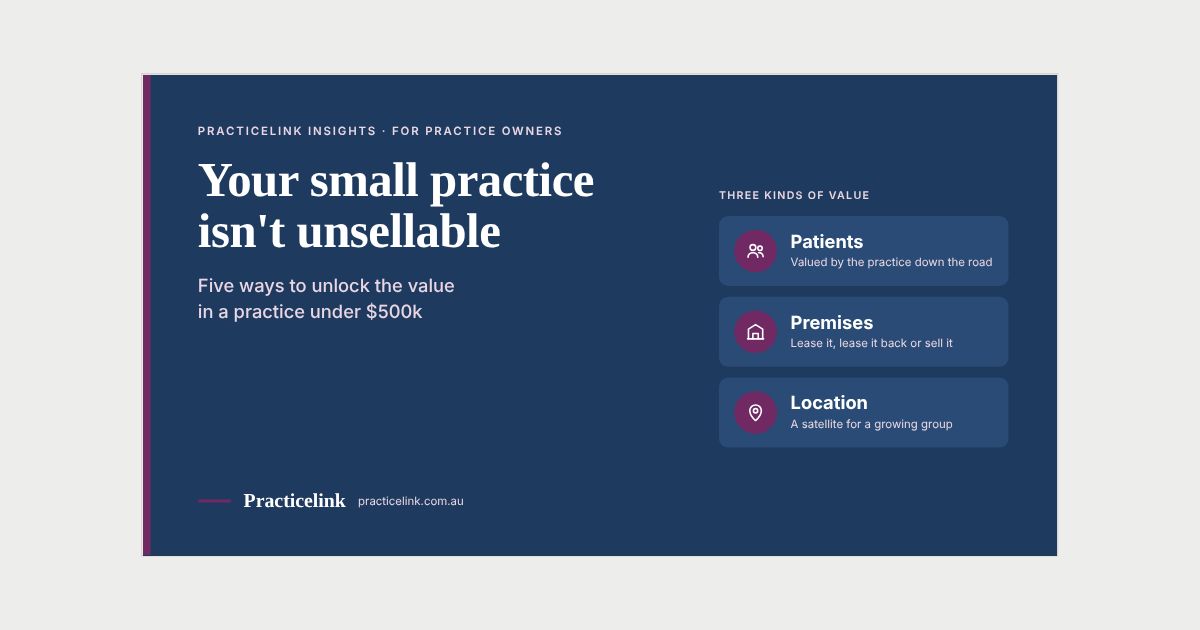
I don’t accept that these practices are worthless. So I looked at what dentists and advisers in the United States and the United Kingdom do with small practices. The answer is that they rarely sell them whole. They break the value into parts, mainly the patients, the premises and the location, and sell each part to the buyer who values it most.
Here are five approaches that work overseas and could work here.
1. Sell your patients to a practice nearby
In the US, a small practice is often not sold to a new owner at all. Instead, its patients move to an established practice in the same area.
The American Dental Association describes two versions [1]. In a merger, the retiring dentist moves into the buying practice and keeps working there under an office-sharing arrangement until they retire, when their patients are folded into that practice. In a goodwill or chart sale, the patient base is sold and the dentist stops practising at the sale. Both work best when the buying practice is close by and treats patients the same way.
What makes this work is that a busy practice down the road may value your loyal patients far more than an individual buyer values your profit figures. Overseas, these deals are priced on the patients who actually transfer [2], and getting that structure right is what protects both sides.
2. Separate the building from the business
If you own your premises, the building may be worth more than the practice. US advisers note that this makes a sale harder when the two are sold together [3]. The answer overseas is to treat them separately:
- Sale and leaseback. You sell the building to an investor, take the cash at settlement, and your practice stays on as a tenant under a long-term lease [4]. One US firm alone has completed more than 27 dental sale-leasebacks this year across two states [5].
- Lease a fitted surgery. If your patients move to a nearby practice, you still own a building fitted out as a dental surgery. You can lease it to a young dentist who wants a first practice without the cost of a fit-out, lease it to a specialist, or sell it.
Combined with a patient sale, this turns one hard sale into two achievable ones.
3. Become a satellite clinic for a growing group
Growing groups in the UK and US buy small practices as satellite clinics around a main practice. One UK group runs three- and four-surgery satellites that refer specialist work back to its main clinic, and only buys premises within 20 miles of it [6]. Some US groups offer to buy a small practice and either move its patients to their clinics or keep it running as one of their own [7].
In Australia, about 90% of clinics are still owner-operated, and the large corporates mostly target bigger practices [8]. The best buyers for a small practice are often local independent groups with two to six clinics that want to grow in your area.
4. Sell to an associate as their first practice
In the UK, the old path from associate to practice owner is no longer a given [9], and Australia is no different. A smaller practice with its own patients, sold at a fair price with some vendor finance or in stages over a few years, can be a cheaper and safer first step for a young dentist than building a practice from scratch.
5. Lift the practice above the $500,000 line first
If your practice is just under $500,000, a year or two of preparation may put it back in the normal market. US advisers stress the value of recurring revenue, because it makes a buyer more confident that income will continue after the sale [10]. In practice that can mean:
- An in-house membership plan for patients without health fund cover
- Reactivating patients who are overdue for recall
- Adding hygiene or oral health therapist days
What this means for you
A practice under $500,000 is not worthless. It is simply worth different things to different buyers. Your patients have real value to the practice down the road. Your building has value to an investor or a young dentist. Your location may have value to a group that wants to grow in your area.
The mistake is waiting until you have cut back to two days and then trying to sell the whole practice as one package. The earlier you plan, the more of these options stay open.
Why not go it alone?
The ideas are simple. Making them work is not. A patient transfer only succeeds if:
- The right buyer is found. The practice nearby has to share your approach to care, or your patients won’t stay.
- Your patients are valued properly. Active patients, recall habits and treatment mix all change what they are worth, and a poorly structured deal can leave you paid for far fewer patients than you hand over.
- The legal rules are followed. Patient records, privacy obligations, staff entitlements and the premises all need handling correctly.
- Staff and patients stay loyal. How and when the change is announced makes the difference between patients following your recommendation and drifting away.
The rules for transferring patient records and selling premises are different in Australia, so get advice from a lawyer and accountant before choosing a path. The ideas above come from overseas markets, and the US figures are given for comparison only.
Thinking about your own practice? Practicelink has a database of more than 13,000 dentists, including practices looking to grow and associates looking to buy. If your practice is under $500,000, or heading that way, contact me for a free, confidential conversation about which option fits you: jan@practicelink.com.au
This article is general information only and is not legal, tax or financial advice.
References
- American Dental Association. What makes a successful sale?
- Hygienetown / Dentaltown. Patients, patients, patience
- Dental Products Report. Dental practice transitions and real estate conveyances
- Dental Economics. Maximize real estate when selling your dental practice to a DSO
- Dentistry Today. CrownPoint Partners dental sale-leaseback transactions
- Dentistry.co.uk. How our mixed practice works
- Dental Associates. Dental practice acquisition
- BDO Australia. Navigating the future: trends, challenges and opportunities for Australian dental practices
- British Dental Journal. On the Portman and Dentex merger
- Dentaltown. Ways to maximize the value of your dental practice, part II: recurring revenue