
Right now, Practicelink has more than 100 qualified buyers looking for dental practices in Victoria, New South Wales, the ACT, Queensland and South Australia. Most want smaller clinics of two or three chairs, with fees from about $700,000 to $2 million or more. And most would prefer to buy from a dentist who plans to retire in the next one to three years.
If that sounds like you, the timing has rarely been better. But there is also a good reason not to leave your planning too late.
The tax rules change on 1 July 2027
The Federal Government has announced that from 1 July 2027, the 50% capital gains tax discount will be replaced with cost base indexation and a 30% minimum tax on real capital gains [1].
The changes are not retrospective. Value built up before 1 July 2027 keeps the old 50% discount, whenever you sell [2]. The four small business CGT concessions, including the ones for selling your business to retire, are staying [3]. The turnover threshold for the small business 50% active asset reduction is also set to rise to $10 million [4].
What this means for you depends on your structure, your age and how long you have owned the practice. Some owners may benefit from a valuation as at 30 June 2027, or from restructuring during the new rollover relief window [4]. These are questions for your accountant, and the sooner you ask them, the more choices you have.
The problem with leaving it late
Most sole practitioners plan to slow down before they sell. But in a small practice, cutting back your days usually means fees fall, profit falls faster and the practice is worth less. Below about $500,000 in fees, many practices struggle to sell at all.
The answer is to plan the handover while your practice is still at full strength.
Internal Business Succession Planning
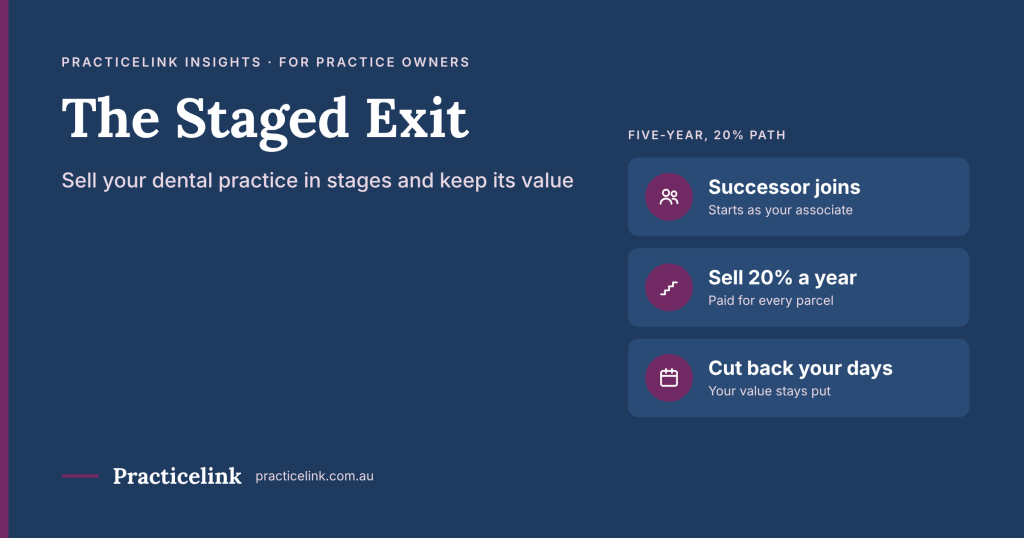
That is why we created Internal Business Succession Planning: a structured, three-stage process for dentists who want to retire within the next five years.
- Successor engagement. Find the right successor, often an associate you already have or one of our buyers, and bring them in without unsettling your patients or staff.
- Value planning. Benchmark your practice against top performers, identify what drives its value and set clear targets.
- Execution support. Put the agreements, funding and timetable in place, often as a staged sale of 20% or 25% a year, so you can cut back without losing value.
The aim is simple:
- Reduce the practice’s reliance on you, and sell on your terms
- Attract and keep the right successor
- Improve profit and value before you sell
- Make decisions using real benchmarking data
Looking for an associate first?
Not every owner is ready to sell today. Many of our buyers would happily start as a long-term associate with a view to buying in later. If you need a good associate now, talk to us. It may be the first step in your succession plan.
Start the conversation
Whether you are ready to sell now or planning for the next few years, a confidential conversation costs nothing.
Contact Jan Gray: jan@practicelink.com.au
This article is general information only and is not legal, tax or financial advice. The tax changes described were announced in the 2026–27 Federal Budget; check the current position with your accountant.
References
- Australian Small Business and Family Enterprise Ombudsman. Essential business updates
- Australian Government Budget 2026–27. Capital Gains Tax and Discretionary Trusts Reform – Small Business Explainer
- The Treasury. Capital Gains Tax and Discretionary Trusts Reform: small business explainer
- CPA Australia. Preparing for tax time: change is in the wind